
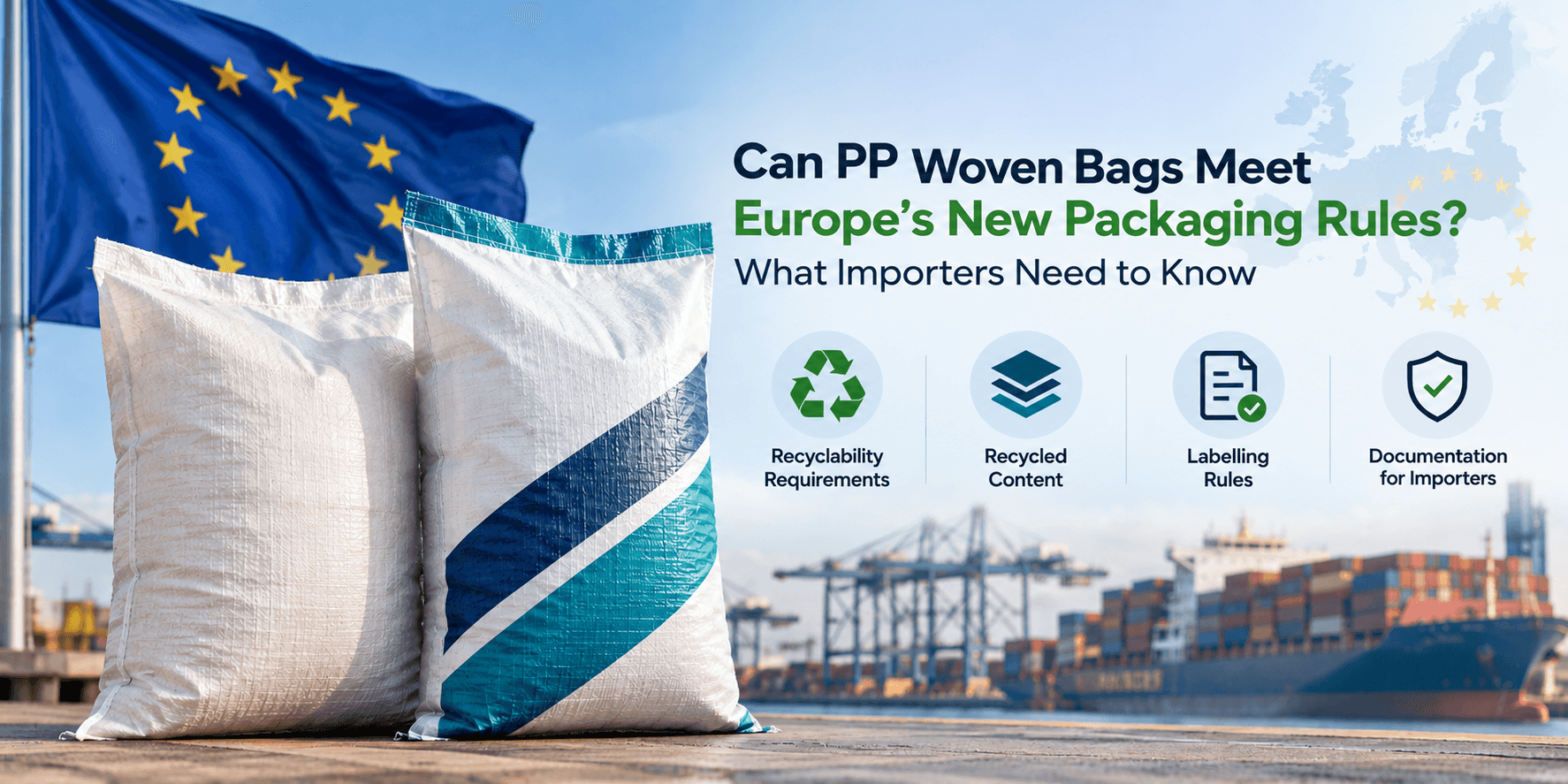
EU PPWR compliance is no longer just a future consideration. Since 12 August 2026, the Packaging and Packaging Waste Regulation (EU) 2025/40 has applied across the EU, introducing requirements for packaging substances, recyclability, recycled content and labelling.
For European buyers sourcing PP woven bags from India, the key question is not simply whether a bag is made from polypropylene. It is whether its complete construction, intended use and supporting documentation meet the applicable requirements.
Here are the technical points importers should check.
1. PPWR: What applies now?
The PPWR is a directly applicable EU regulation covering packaging placed on the EU market, including packaging manufactured outside Europe. Its obligations have different implementation dates, so the regulation should not be treated as a single certification deadline.
For PP woven bags, the immediate priorities are:
- Chemical restrictions: including the combined heavy-metal limit and specific PFAS restrictions for food-contact packaging.
- Conformity documentation: technical information supporting the applicable requirements.
- Recyclability: existing requirements continue during the transition to the PPWR's detailed design-for-recycling framework.
- Future requirements: recycled-content targets and harmonised packaging labels have their own timelines.
Official reference: EU Regulation 2025/40 — PPWR.
2. Chemical restrictions: Heavy metals and PFAS
Under Article 5(4), the combined concentration of lead, cadmium, mercury and hexavalent chromium resulting from substances present in packaging or its components must not exceed 100 mg/kg.
Article 5(5) also restricts PFAS in food-contact packaging from 12 August 2026. Packaging may not be placed on the EU market when PFAS concentrations meet or exceed the applicable threshold:
| PFAS parameter | Threshold (ban at or above) |
|---|---|
| Any individual PFAS under targeted analysis | 25 ppb |
| Sum of targeted PFAS | 250 ppb |
| PFAS including polymeric PFAS | 50 ppm |
These thresholds have specific analytical conditions and should be interpreted alongside Article 5(5), rather than as interchangeable tests.
What this means for PP woven bags: assess the components used in the finished bag—not only the base resin. Depending on the construction, this includes printing inks, coatings, adhesives, lamination films and liners.
The manufacturer must maintain the technical documentation needed to demonstrate compliance with the applicable substance requirements. Evidence may include relevant supplier declarations, material specifications and targeted laboratory testing.
Source: PPWR, Article 5.
3. Recycled content: Which target applies to your bag?
Article 7 establishes minimum recycled-content targets based on plastic recovered from post-consumer waste.
| Packaging category | First target | 2040 target |
|---|---|---|
| Contact-sensitive packaging made from PET as the major component, except single-use beverage bottles | 30% | 50% |
| Contact-sensitive packaging made from other plastics, except single-use beverage bottles | 10% | 25% |
| Single-use plastic beverage bottles | 30% | 65% |
| Other plastic packaging | 35% | 65% |
The first targets apply from 1 January 2030 or three years after the relevant implementing act enters into force, whichever is later. The 2040 targets are set for 1 January 2040.
These targets are calculated by packaging type and format as an average per manufacturing plant and year; they are not necessarily an identical recycled-content percentage in every individual bag.
An important distinction for woven PP sacks
Do not automatically classify every bag as "other plastic packaging."
Under the PPWR definition, contact-sensitive packaging includes packaging intended to be used for products covered by specified legislation, including food-contact materials and certain feed products. Consequently, a bag's intended use can affect the applicable recycled-content category.
A sack supplied for industrial material may therefore require a different assessment from a sack intended for food or animal feed.
The regulation also imposes conditions on the origin and recycling of qualifying post-consumer material. Importers should not assume that any recycled PP purchased in India will automatically count toward EU recycled-content targets. The applicable calculation, verification and third-country equivalence rules must be checked.
Practical action: record the recycled material percentage, source, supplier documentation and intended packaging category before making a recycled-content claim.
4. Recyclability: Does lamination matter?
Article 6 requires packaging placed on the EU market to be recyclable. The detailed PPWR design-for-recycling grading system is being phased in.
The regulation schedules the design-for-recycling criteria from 1 January 2030 or 24 months after the relevant delegated acts enter into force, whichever is later. Recycled-at-scale requirements follow a separate timetable from 2035 or later, as specified in Article 6.
For woven PP bags, the construction deserves particular attention:
- Unlaminated PP: A predominantly polypropylene structure can provide a simpler starting point for material assessment, but it is not automatically compliant.
- Laminated PP: BOPP or other film layers, adhesives and coatings must be considered as part of the complete package.
- Bags with liners: A separate inner liner adds another component whose compatibility with collection, sorting and recycling should be evaluated.
A laminated bag is not automatically non-recyclable, and an unlaminated bag is not automatically recyclable under every applicable criterion. The relevant assessment depends on the complete construction, the applicable packaging category and the EU criteria in force.
5. What documentation should an EU importer request?
Under the PPWR, manufacturers and importers have separate responsibilities. Manufacturers must prepare the applicable technical documentation and conformity declaration; importers must perform their required checks and retain access to the relevant documents.
For each bag specification, buyers should request:
| Document or information | Why it matters |
|---|---|
| Material breakdown | Identifies the woven fabric, lamination, liner, inks and other components. |
| Supplier declarations | Supports assessment of material composition and applicable chemical restrictions. |
| Relevant test reports | Provides evidence for specific requirements; testing should match the material and intended use. |
| Recycled-content records, where applicable | Supports traceability and future recycled-content claims. |
| Technical documentation and EU Declaration of Conformity, where required | Supports the applicable PPWR conformity process. |
| Product and batch identification | Helps maintain traceability and control changes between orders. |
For single-use packaging, the PPWR requires importers to keep a copy of the EU Declaration of Conformity available for five years; the period is ten years for reusable packaging.
A generic certificate or test report should not be treated as proof that every requirement has been met.
6. Labelling and producer responsibility
Article 12 establishes harmonised material-composition labelling. Its general application date is 12 August 2028 or 24 months after the relevant implementing acts enter into force, whichever is later.
Before finalising printed artwork, buyers should confirm the requirements applicable to the destination market and the packaging's intended use.
Extended producer responsibility (EPR) also needs attention. Registration, reporting and fees depend on the producer's role and the relevant Member State arrangements. An importer should establish who is responsible for these obligations before the goods are placed on the market.
7. PPWR checklist before placing an order
For an EU-bound PP woven bag, buyers should:
- Define the application: industrial, fertiliser, food or animal feed.
- Freeze the construction: record fabric, bag weight, lamination, liner, inks and other components.
- Verify applicable substance requirements: use relevant material evidence and testing where needed.
- Classify the recycled-content category: do not assume every bag has the same target.
- Assess recyclability: consider the whole package and the applicable transitional timetable.
- Agree on documentation: establish which technical records and declarations the manufacturer can provide.
- Confirm importer obligations: clarify EPR, labelling and market-placement responsibilities.
What should Indian PP woven bag manufacturers do now?
For manufacturers, the most useful first step is not to purchase a generic "PPWR certificate." It is to establish a product-specific technical file, collect material information from upstream suppliers and maintain traceable production records.
Food-contact packaging requires separate attention to the applicable food-contact legislation; PPWR compliance alone does not establish food-contact suitability.
For European buyers, a clear specification and supporting documentation make it easier to evaluate a supplier before committing to a commercial order.
Sourcing PP woven bags from India? Contact Armah Traders with your required dimensions, bag weight, construction, printing, application and destination. The specification can then be reviewed against the relevant technical and purchasing requirements.
Looking for a PP woven bag manufacturer in India?
Armah Traders supplies PP woven bags with customised specifications and laminated or unlaminated options, depending on the product requirement.
Share your bag dimensions, weight, construction, printing requirements, order quantity and destination to discuss your packaging needs.
Contact Armah Traders for a quotationOfficial references
- Regulation (EU) 2025/40 — full legal text
- European Commission — PPWR FAQs, 3 August 2026
- European Commission — PPWR overview
This article provides general information, not legal advice. Requirements and implementation dates should be checked for the specific packaging design and intended use before placing products on the EU market.