
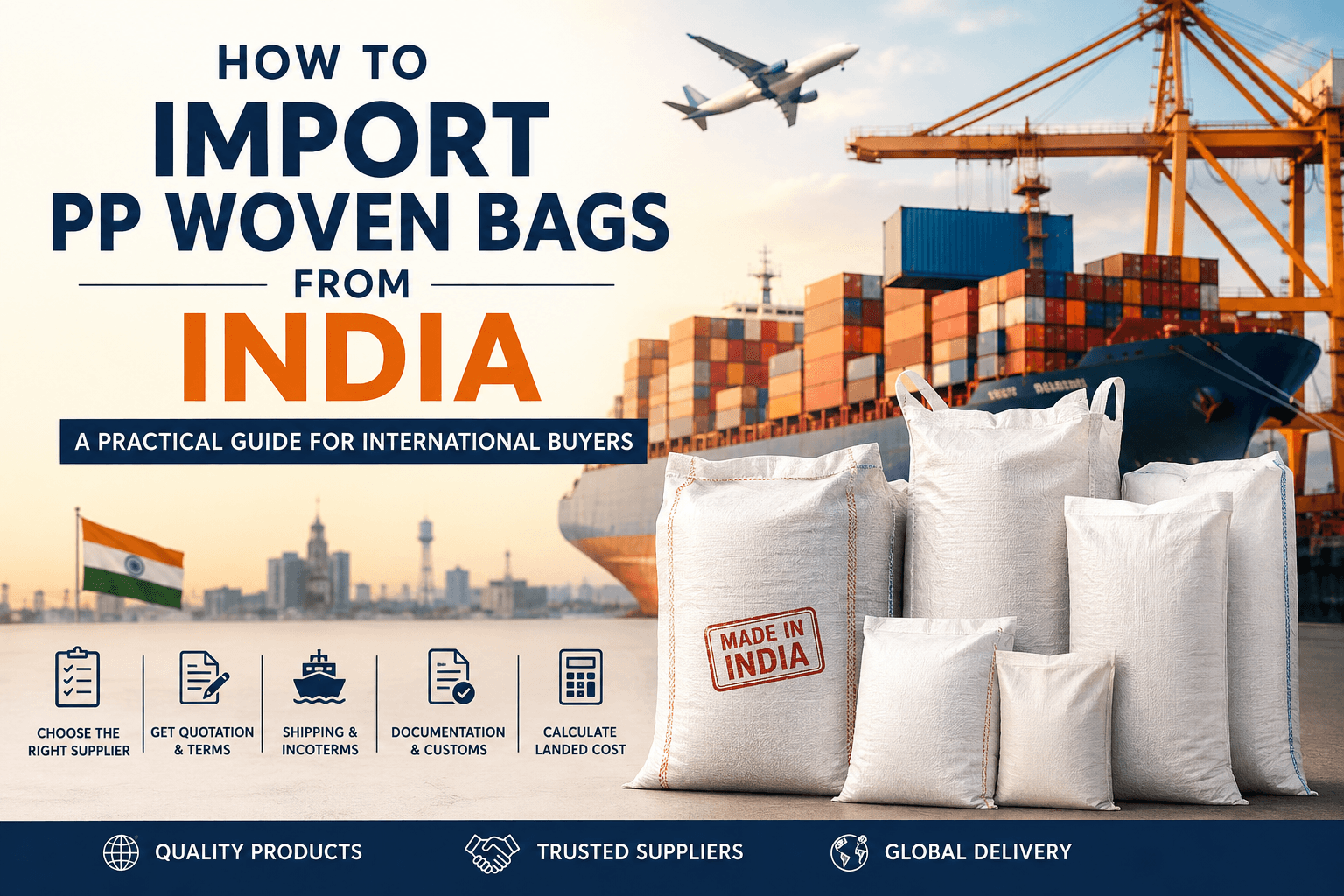
Importing PP woven bags from India is fairly straightforward. The part that needs attention is making sure you and the supplier are talking about the same bag.
Before asking for prices, get the specification clear. Then compare suppliers on the same basis, understand exactly what the quoted price includes, and work out your landed cost before placing the order.
1. Start with a clear specification
“50 kg PP woven bag” is not enough for a proper quotation.
The same 50 kg bag can be made with different weights, dimensions, tensile strength, lamination and printing. These differences affect both the price and performance.
At a minimum, give the supplier:
| Application | Animal feed / Food Grains / rice / flour |
| Capacity | 25kg / 50 kg |
| Finished size | 60 × 95 cm |
| Bag weight (grams) | Specify required value |
| Lamination | If required |
| Printing | Number of colours and sides |
| Colour | White / custom |
| Quantity | Example: 100,000 bags |
| Destination | Destination port / country |
| Incoterm | FOB / CIF |
Send the same specification to every supplier. Otherwise, you can easily end up comparing a cheaper quotation simply because the bag is lighter, smaller or made differently.
2. Find and vet the supplier
First, understand who you are actually buying from.
Ask whether the company is the manufacturer or a trading company. Neither is automatically better. What matters is whether the supplier can consistently deliver the specification you approve.
Before a first container order, ask for:
- Company and factory details
- Business and registration documents — IEC, GST, company registration and other relevant documents
- Production capability
- Product samples
- Production lead time
A live factory video call can also be useful. Ask the supplier to show the production and packing areas rather than relying only on catalogue photographs.
You are not trying to make the supplier pass an impossible test. You simply want enough information to be comfortable putting a container order in their hands.
3. Compare quotations properly
Don't compare suppliers on the number beside "price per bag" alone.
Check that the quotations are based on the same:
- Specification
- Quantity
- Currency
- Packing
- Payment terms
- Incoterm
A supplier quoting $0.0820 FOB and another quoting $0.0900 CIF are not necessarily competing on the same price.
4. Approve the sample before production
Before placing a container order, check the physical sample against your specification.
Check the dimensions, bag weight, tensile strength, lamination, stitching, colour and overall quality.
Once approved, keep the specification and sample as the reference for production.
5. Export documentation
For exports from India, DGFT lists the applicable transport document, Commercial Invoice cum Packing List and Shipping Bill/Bill of Export among the mandatory export documents. Separate Commercial Invoice and Packing List documents are also accepted. Additional documents can apply depending on the goods, destination or specific regulatory requirements. DGFT export documentation
Your exporter, freight forwarder and destination customs broker should confirm the final document set for your shipment.
6. The simplest way to place your first order
Copy this RFQ
Subject: RFQ – PP Woven Bags

Application:
Bag capacity:
Bag Colour:
Finished size:
Bag weight:
Lamination:
Printing:
Quantity:
Destination port:
Preferred Incoterm:
Final takeaway
Importing PP woven bags from India isn't especially complicated. Most problems come from unclear specifications and incomplete cost comparisons, not from the shipping process itself.
Define the bag properly. Get comparable quotations. Check the sample. Understand the Incoterm. Plan the container. Then calculate the full landed cost before you place the order.
A few extra questions at the beginning can save a much more expensive conversation after the container arrives.