
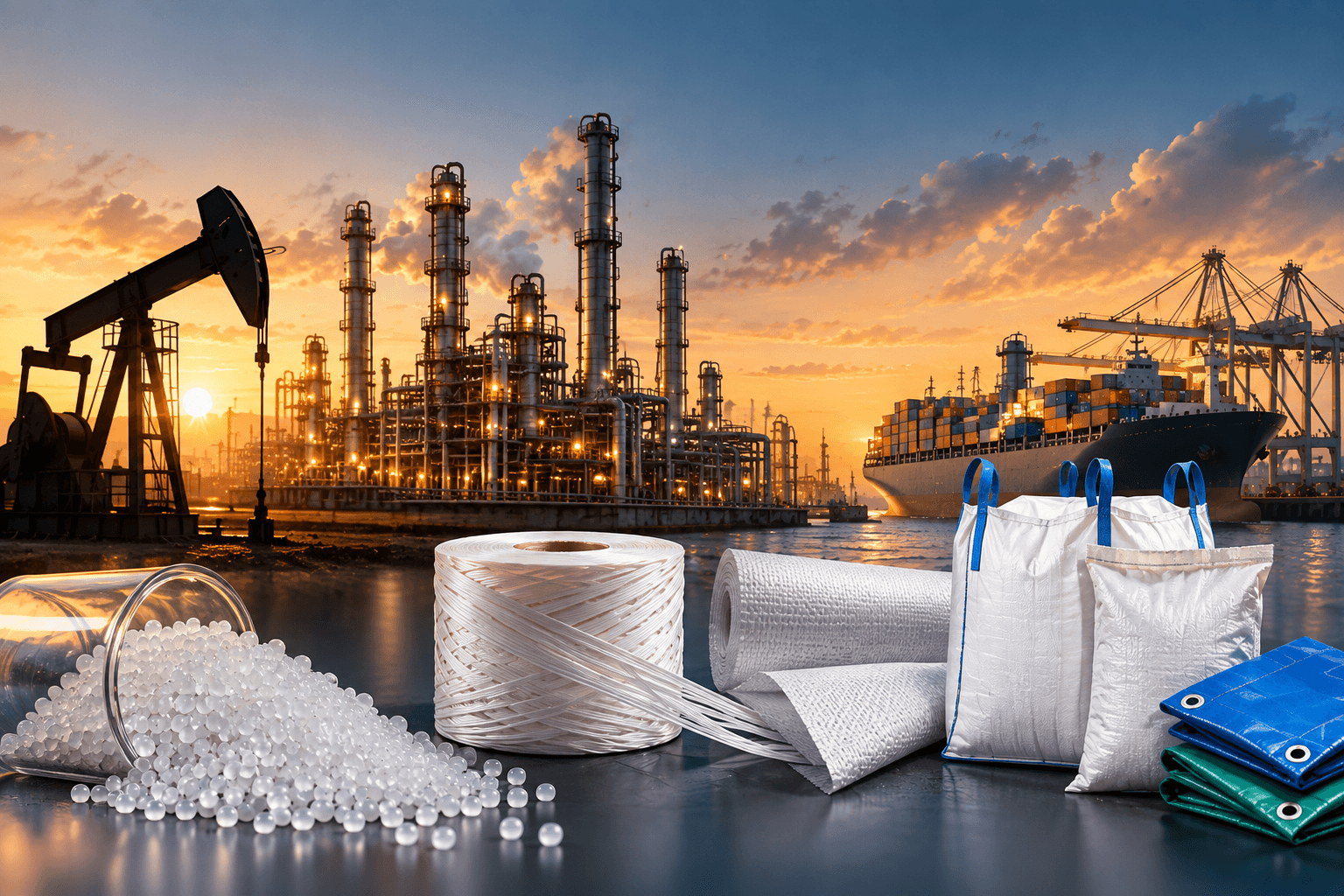
A war in the Persian Gulf sounds like an oil story. A shipping disruption sounds like a freight story. But for anyone buying PP woven bags, FIBC, tarpaulins or other polypropylene products, it can become a packaging story surprisingly quickly.
That is the part of the current Strait of Hormuz crisis that is easy to miss.
The connection is not as simple as “oil goes up, plastic goes up.” Between the two are refineries, petrochemical feedstocks, propylene, polypropylene, inventories, freight, insurance, currency and regional supply-demand conditions.
But when several of those variables move at the same time, the effect can eventually reach the price a packaging buyer sees on a quotation.
The short version
Hormuz
A major energy and shipping chokepoint is under severe disruption.
$100+
Brent has moved above the $100/barrel level during the latest escalation.
PP
Polypropylene is one of the most important material inputs in raffia products.
Freight
Shipping, insurance and transit risk can raise landed cost even without a matching resin increase.
Hormuz is much bigger than an oil headline
The Strait of Hormuz connects the Persian Gulf with the Gulf of Oman and the Arabian Sea. For decades it has been one of the critical arteries of global energy trade.
Reuters reported that only seven vessels transited the strait on September 10, compared with a recent 10-day average of 15 and a pre-war daily average of roughly 125 commercial vessels. The same reporting noted that the waterway had historically carried around one-fifth of global oil and LNG supply.
Reuters - Hormuz shipping traffic falls to single digits
That matters even to companies that never purchase crude oil directly.
Why? Because a disruption to a major energy corridor creates several simultaneous effects:
- physical supply becomes less predictable;
- shipowners demand more compensation for risk;
- insurance becomes more expensive;
- vessels become harder to position;
- alternative routes become more valuable;
- buyers start paying more attention to inventory.
In other words, the market begins pricing uncertainty, not just physical barrels.
Shipping is already reacting
Record tanker rates
Reuters reported VLCC charter rates from the Gulf of Oman to China reaching a Worldscale rate of 450, equivalent to roughly $11.50 per barrel - the highest level since the benchmark was introduced earlier in 2026.
Source: Reuters, 11 September 2026
This is important because oil is not the only thing that travels by sea.
Petrochemical feedstocks, polymers, finished packaging, equipment and industrial inputs all compete for the same global shipping capacity and are exposed to the same insurance and security environment.
Reuters - Oil tanker rates hit record highs
Then the shock moves into petrochemicals
This is where the connection to plastics begins.
Polypropylene is not produced from crude oil in one simple step. The plastics chain involves petrochemical feedstocks, including propylene, which is then converted into polypropylene.
The exact relationship varies by region and production route. Propylene availability, naphtha and LPG economics, refinery operations, cracker economics, producer margins, plant outages and local demand can all influence PP pricing.
The International Energy Agency notes that the chemical industry uses oil and gas both as energy and as feedstock, while feedstock flexibility differs significantly by region.
International Energy Agency - Oil use in industry
That is why it is dangerous to use a simplistic formula such as:
Crude +10% = polypropylene +10%.
It doesn't work like that.
What does happen is that a large upstream shock changes the economics of replacement material. The effect can then strengthen or weaken depending on regional PP supply and demand.
What is happening to PP in South Asia?
The current market provides a useful example.
As of 9 September 2026, PP raffia in the South Asian market was assessed at approximately $1,325/MT, with Brent at around $98/bbl in the referenced weekly assessment.
The benchmark data also notes that PP raffia pricing is closely linked to Brent and naphtha-to-propylene economics, but that Chinese exports, Indian domestic demand and inventory cycles can widen or compress the relationship.
The PP market is reacting — but not mechanically
The relationship between crude oil and polypropylene becomes much clearer when we look at the actual weekly data.
The chart below compares the South Asian PP Raffia benchmark with Brent crude. The two series often move in the same broad direction, but the timing and magnitude can diverge substantially.
Armah Market View
PP Raffia Price vs Brent Crude
South Asia PP Raffia benchmark · USD/MT vs USD/bbl
PP Raffia
$1,325/MT
Brent
$98.00/bbl
PP movement
+52.3%
Brent movement
+45.2%
Source: India Pack / Platts South Asia PP Raffia benchmark and Brent data.
View source data →That divergence is important. A polymer market can continue rising after crude has already turned lower, or remain firm while crude falls, because inventories, supply availability, regional demand, producer offers and import economics can temporarily dominate the upstream signal.
That last point is important. A polymer benchmark should not be interpreted as a direct forecast of a finished bag price. The manufacturer still has to convert resin into raffia tape, weave the fabric, print or laminate it, cut and stitch it, pack it and ultimately ship it.
From polypropylene to raffia - where the bag actually begins
A PP woven bag starts much earlier than the cutting and stitching department.
The chain
01 · Upstream
Crude oil / gas → petrochemicals
02 · Polymer
Propylene → polypropylene
03 · Raffia
PP → tape → woven fabric
04 · Packaging
Fabric → bag / FIBC / tarpaulin
This is why a change in polymer replacement cost matters. Polymer is typically one of the largest variable inputs in a PP woven product.
But it is only one part of the final price.
Why a 10% PP increase does not mean a 10% bag increase
Suppose, purely for illustration, that PP polymer represents 60% of a particular product's manufacturing cost.
| Example | Amount |
|---|---|
| Original manufacturing cost | $100 |
| Polymer component at 60% | $60 |
| Polymer rises 10% | $66 |
| New simplified manufacturing cost | $106 |
In this simplified example, a 10% increase in PP creates roughly a 6% increase in the original manufacturing cost, before considering everything else.
This is not an industry-wide cost formula. A thin commodity sack, a heavily laminated BOPP bag, a printed fertilizer bag and a large FIBC have very different cost structures.
The useful lesson is simply this:
You should model the polymer exposure of the product, not assume that every movement in crude passes through dollar for dollar.
Then comes the second shock: freight
A packaging buyer can sometimes face an increase even when the factory keeps its material price relatively stable.
The reason is freight.
Reuters reported that VLCC rates from the Gulf of Oman to China had reached approximately $11.50 per barrel, with shipowners demanding significantly higher compensation for the risk of operating around the disrupted region.
War-risk insurance is another variable. Reuters reported that insurance costs for oil cargoes could reach up to 6% of cargo value, while war-risk premiums in some cases were reported as high as 10%.
Reuters - Hormuz transit and insurance costs
These figures relate to energy cargoes rather than a specific PP woven bag shipment. But they demonstrate the broader mechanism: when security risk changes the economics of maritime transport, freight and insurance become part of the pricing conversation throughout the supply chain.
Why low-value, high-volume packaging feels freight shocks
Packaging has a special vulnerability to logistics costs.
A container can carry hundreds of thousands of individual bags depending on the product and packing configuration. That means a relatively small change in freight per container can become meaningful when translated back into a very low unit price.
The effect becomes even more important when the buyer compares suppliers on FOB price rather than delivered cost.
What this means for PP woven, FIBC and tarpaulin
The same upstream shock can reach several product families because they share the same polymer ecosystem.
| Product | Upstream connection | Other major sensitivities |
|---|---|---|
| PP woven bags | PP resin → raffia tape → woven fabric | Printing, lamination, stitching and freight |
| FIBC | PP resin → woven fabric | Fabric weight, safety factor, components and liners |
| Tarpaulin | PP woven fabric + coating / lamination | Coating, GSM, dimensions and freight |
Why buyers should watch more than crude oil
Watching Brent is useful, but it is not enough to predict the price of a PP woven bag.
For a packaging buyer, a better dashboard is:
Brent crude
Broad upstream energy signal
Propylene
Closer feedstock indicator for PP
Polypropylene
Direct material input
Freight
Changes the delivered cost
FX
Changes the effective import price
Lead time
Signals physical supply pressure
What should packaging buyers do now?
There is no single perfect response to a volatile polymer market. But procurement can become more disciplined.
First, freeze the specification.
A supplier cannot be compared properly if one quotation is for a 90-gram bag and another is for a 105-gram bag with different GSM, printing and lamination.
Second, separate material risk from freight risk.
Ask the supplier whether the quotation is based on current replacement resin, existing inventory or a longer-term arrangement. Then look at freight separately.
Third, shorten quotation validity when markets are moving quickly.
A seven-day quotation and a thirty-day quotation carry different levels of commercial risk when polymer and freight markets are volatile.
Finally, think about supply continuity.
A slightly higher factory price can sometimes be cheaper than a lower-priced order that arrives late, requires emergency freight or forces the buyer to carry excessive safety stock.
Where does India fit into this?
The current crisis also reinforces a broader trend in international procurement: buyers are increasingly evaluating supply chains, not just suppliers.
India cannot automatically replace every disrupted source, and it would be misleading to suggest that Indian packaging is always the cheapest option.
The opportunity is different.
For buyers looking to diversify manufacturing geography, India's large polymer-processing ecosystem and established export infrastructure make it one of the sourcing options worth evaluating.
For PP woven products specifically, the relevant comparison is not simply:
Who offers the lowest bag price?
It is:
Which supplier can give me a competitive landed cost with reliable quality and predictable supply?
The bigger picture
A shipping chokepoint can become a polymer problem. A polymer problem can become a packaging problem. And a packaging problem eventually becomes a procurement problem.
That is the real lesson from Hormuz.
The price on a PP woven bag is determined long before the bag reaches a stitching machine. It is influenced by an international chain stretching from energy markets and petrochemicals to resin, raffia, manufacturing and freight.
For buyers, that makes one thing increasingly important: understand the chain behind the quote.
Sources & methodology
This article separates current market observations from illustrative cost examples. PP and finished packaging prices vary by grade, region, producer, inventory position, contract structure, FX, freight and demand. The cost example above is a sensitivity model, not an industry-wide cost benchmark.